Showing posts with label data. Show all posts

02 July 2014

If I Only had an Emotion Chip

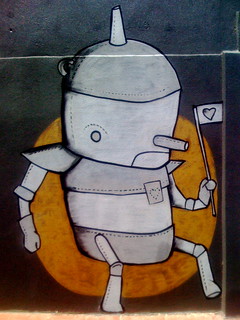
Tin Man
Image ©Bulent Yusuf

The non-biological entity lacking the ability to emote – it’s a familiar tale. He’s Data in Star Trek , he’s the Tin Man in The Wizard of Oz , he/she/it is most of the sci-fi robots you’ve ever read about or seen in movies.

The mythology of animate beings possessed of human form but not of human sentiments is ancient. In Jewish folklore, rabbis channelling the power of God raised magical ‘golems’ fashioned from mud. Though usually intended to protect their maker and his people, these beings sometimes ran amok, their self-control and moral judgement evidently compromised by their lack of soul. Only the ‘one true God’ is cogent enough to raise an exceptional mud-being – Adam – complete with the full set of human attributes.

In panel-beating the ‘automatones’ to burnished life, the Greek blacksmith-god Hephaestus put to shame the crude, daub creations of the rabbis. According to Homer, his ‘ Kourai Khryseai ’ – ‘Golden Maidens’ – were ‘in appearance like living young women’ and had ‘intelligence in their hearts’. Yet they were slaves, manufactured only to serve their fiery master.

And in more recent imaginings, the manufactured automaton is still a captive chattel. The word ‘robot’ – from the Czech word ‘robota’, meaning ‘forced labour’ or ‘serf labour’ – has only been in common usage since 1921, when Karel Čapek introduced it in his dystopian play R.U.R. (Rossum’s Universal Robots).

Although portrayed in the film as robotic in form, the erotically-charged ‘Maschinenmensch’ (machine-human) from Fritz Lang’s Metropolis (1927) was written as a magical construct. Her fabricator, the evil scientist/magician Rotwang, swathes his creation in a pleasingly rivet-less ‘skin’ to double as the seraphic heroine, Maria, and foment riot among the populace. (In less heavily edited versions of Metropolis , the Maschinenmensch also houses the soul of Hel, Rotwang’s former lover.) Though more Golden Maiden than robota, this beguiling gynoid (female android) lacks the intelligent autonomy of Hephaestus’ inventions. An instrument of the despotic Rotwang, she does his bidding without mercy, without self-determination, and without emotion.

With his I, Robot series of short stories, Isaac Asimov brought machine men into the popular consciousness. Published in the 1940s, his tales of robots with nicknames – including ‘Speedy’ (SPD-13), ‘Cutie’ (QT1), ‘Dave’ (DV-5), and of course ‘Robbie’ (RB) – also introduced sci-fi readers of the Rocket Age to the concept of machine morality. In the story ‘Robbie’, the robot’s ethical programming drives him to save the life of a young girl. Asimov’s ‘ Three Laws of Robotics ’ from these stories have since become a subject of serious debate among artificial intelligence (AI) researchers and technology ethicists.

Data from Star Trek seems an amalgam of Robbie and the Tin Man. Like Robbie, he gains the trust of those around him through acts of sound moral judgement; gradually, it comes to matter less to his human colleagues that he is a ‘machine’. And like the Tin Man, he wishes to have emotional capabilities. But hold on a minute. Isn’t that a desire ? How could an entity without emotions ever have desires?

Ah, but,’ said my wife when I discussed this with her recently, ‘Data is programmed to want to have emotions.’ Fair enough, but what does that mean ? Does that programming of desire to have desires not constitute a desire, and therefore an emotion? And what about our own desires? We do tend to distinguish between our various ‘wants’ when we think about them, considering some of them dreams and hopes, and others mere ‘drives’ and ‘instincts’. And, in some ways, we consider our emotions to be separate from our desires: our desires are the outcomes we want, whereas our emotions are how we feel about actual and potential outcomes. Perhaps, then, we are comfortable with classing Data’s wish to have emotions as a mere drive – one unconnected to any emotional content.

In his book The Emotion Machine , AI pioneer Marvin Minsky challenges us to think about the neurological mechanisms of emotion. He points out that

Saying that someone is like a machine has come to have two opposite meanings: (1) “to have no intentions, goals, or emotions,” and (2) “to be relentlessly committed to a single purpose or policy.” Each meaning suggests inhumanity, as well as a kind of stupidity, because excessive commitment results in rigidity, while lack of purpose leads to aimlessness. 1

It is notable that Minsky conflates intentions and goals with emotions – notable because most of us set emotions way above ‘mere’ goals in the ‘hierarchy’ of cognitive abilities. We do this to the extent that we may not even think of emotion as a cognitive ability. Data has goals – they may be pre-programmed, but they are still goals. Does he have intentions , though? Well, without emotions, he can’t have his ‘heart set’ on anything (and achieving his pre-programmed goals can’t be about fulfilling his ‘heart’s desire’) , but can he have something else ‘set’ when he ‘aims’ to do something?

Set’ is perhaps the wrong word; it seems in the nature of emotions to be dynamic and un set (indeed, often ‘unsettled’ and sometimes ‘unsettling’). In Incomplete Nature , Terrence Deacon discusses the ‘dynamical feel’ and ‘tension’ of emotions:

It is the tension that separates self from non-self; the way things are and the way they could be; the very embodiment of the intrinsic incompleteness of subjective experience that constitutes its perpetual becoming. 2

He goes on to discuss the resistance of the body to thinking, and how our basic drives try to ‘derail’ the delicate energistic processes involved. While conscious, we constantly feel this ‘fluid’ ebb and flow, this ‘tugging’ on our inner mental worlds.

So, Data’s ‘emotion chip’ – when he eventually receives it – must do a complex job: it must dissolve the ‘stupid’ algorithmic rigidity of his programmed behaviour without obliterating his logical faculties, it must instil in him dynamic-tension-causing urges, and it must enable him to reflect upon those tensions in a way that is elevated above them but not separate from them. And it must do all this without putting him into an infinite reboot loop or causing permanent shutdown!

For us, the feeling of struggle when concentrating hard on learning a new skill is, in effect, the feeling of a process of cognitive uninstallation and installation: we are trying to uninstall a too-dynamic-to-do-the-job ‘emotion chip’, and to install an ‘off by heart’ ‘algorithmic rigidity chip’. Of course we sometimes want to use our new skills – artistic, musical, empathetic – to deepen our emotional experience. But in order to do that, we have to sacrifice some of the areas of emotional tension that were involved in the struggle to learn the skill and in the feelings of frustration at not having that now-ingrained outlet. Seems like a fair trade.

The fear of becoming maschinenmenschen is understandable, but perhaps we can learn to better value our ability to automate parts of our minds without losing our esteem for emotion. We can be part-time positronic without losing compassion, without losing heart.


1 Marvin Lee Minsky, The Emotion Machine: Commonsense Thinking, Artificial Intelligence, and the Future of the Human Mind (New York: Simon & Schuster, 2006), 33.

2 Terrence William Deacon, Incomplete Nature: How Mind Emerged from Matter , 1st ed (New York: W.W. Norton & Co, 2012), 512.


07 July 2013

The Art of the Archivist


My friend’s approach to dealing with the accrued data of his life is different to mine: He treats his with reverence; I treat much of mine with cold pragmatism.

This makes little sense. I have experienced the trauma of losing personal-meaning-suffused data when, many years ago, a lightning strike fried my PC and, along with it, the hard-drive containing the sole copies of songs I had written. Losing such data feels a lot like grief, probably because it is grief. You can see such grief in the expressions of those who have lost all their possessions to fire or flood. The rationalist in us may shrug and say, ‘Well, nobody died’; clearly, however, something died – the part of the person that was implicit in their now-destroyed archive.

To a large extent, we take our personal data for granted. It has become easy for us to create (and back-up) vast amounts of it. For some, physical things that cannot be converted into easily-storable binary data have become a burden; for others, an MP3 file could never substitute for a cherished disc of grooved vinyl. But consider, for a moment, the burdens (both physical and metaphorical) of earlier archivists: inscribed stone tablets; purport-laden sheets of carefully-prepared Cyperus papyrus; symbol-etched tree bark, bamboo, bone; ‘illuminated’ codices on parchment of goat skin; and, of course, delicate and easily-corrupted networks of interconnected neurons (present in the brain of the skilled storyteller – in effect, an oral archivist – charged with memorising and relating the history of his/her people).

Ancient archive disasters such as the destruction (by various fires, spaced over hundreds of years) of the Library of Alexandria demonstrate the vulnerability of some of those early systems. Though less vulnerable to complete destruction, well managed modern-day digital archives are still burdensome and, regrettably, still prone to corruption.

For cryonicists like me, the understanding of self as potentially-preservable pattern demands a practical/radical approach to archival. I am my own medium, so my approach to the storage of this particular archive has been to choose a method by which the important parts of the pattern might just survive my death: the cold, radical pragmatism of cryonic suspension. The other practical strand of the required approach (which I have not yet fully addressed) is to do with the archival of the externalised parts of myself – the valued data that I have acquired, created, and sometimes stored, that constitutes my distributed avatar-halo.

An article by Mike Anzis in the April 2013 issue of Cryonics magazine goes into the issues of ‘very long-term storage of personal information and materials’ at length. It’s all delightfully practical. I already knew that the head would be going in the liquid nitrogen ‘box’, but Anzis has the other bases covered too: the physical possessions go in the Alcor storage box; the data archives go onto a Millenniata M-Disc (‘a DVD made out of stone that lasts 1,000 years’), or up to cloud storage services such as Google Drive or SkyDrive. None of this sounds much like encapsulation of an avatar-halo, until, that is, we get to ‘mind files’. LifeNaut and CyBeRev are secure, cloud-based services that allow the user to create a central hub linking together their various online presences, to upload files for secure storage, and to generate (from photos) an avatar that can relay stored information to those granted access to their profile.

My friend already has part of my mind file. Whereas I have misplaced much of the music we created together and the photos taken when we were in a band together, he has kept it all. And he knows where to find it: it is all neatly stored and clearly labelled. Because of his diligence, parts of my life have been preserved that would otherwise have been lost. I admit that I have been careless with my own past, but, paradoxically, that’s not because I don’t care about it; I think it has to do with the fact that the connections to it that remain are painfully tenuous. That’s no excuse, though. I care deeply about the preservation of life, so I should also care deeply about the preservation of the stacked or scattered elements that go together to make a whole one.

Perhaps what is missing from my attitude to archival is the art. My friend feels and knows how to enhance the significance of the objectified data in his hands. For him, a cassette tape containing old songs is more than just that; the spine and the song titles have been inscribed – in his inimitable jagged-pen style – with care, with love, and with moment. He, like other archivists through the ages, makes the object itself, not just the data, radiate significance. This ability to capture meaning and moment is an integral part of his personality. It is what makes him both artist and archivist.

Today is his molybdenum birthday. This piece of writing is my cheapskate gift to him. Happy birthday, Scott. Keep on caring. And keep on keepin’.

05 March 2010

Data

How much data do you have to deal with? How much do you carry with you on a daily basis? Is it logical? Is it encrypted? Is it necessary? How do you perceive that 'weight' of data? What is your relationship with it?

You probably haven't asked yourself any of these questions, but my work has put me into the role of 'data controller', so I feel a personal responsibility to maintain the integrity of some terabytes of data. This can be a logistical problem, and it's an issue that we will all increasingly have to deal with.

I once lost some valuable data. I had written some songs and stored them on the hard drive of my PC. I didn't keep backups at that time. My modem was blown out by a lightning pulse and it damaged other components, including the hard drive. A friend eventually managed to retrieve some of the songs for me, but I will not forget the initial sickening realisation that I had not taken steps to protect what had taken me so long to create. I learned to keep backups.

Terabyte drives are now common but, surprisingly, that's probably not enough backup space even for the average small business. Bloated software has led to bloated file sizes; the availability of large amounts of storage space means that workers don't run up against data storage problems on a regular basis, so they continue to create massive graphical files; people dump their mp3 collections to office file servers; incremental backups going back weeks eat up further space. Little or nothing will be done about these issues. Data storage will continue to grow in capacity and transfer speeds will increase. None of this will matter.

Many of us now carry large amounts of data around with us. Think about how it mounts up. The pen drive; the SD card in the camera; the hard drive in the ipod; the mini-SD in the mobile phone. This could easily amount to 70GB or more of capacity, without even taking netbooks or laptops into account, although most of us only use a fraction of that available capacity to store all our data. How important is all that data to us and how would we feel if we lost vital parts of it? It's OK to admit that you would feel a great deal of emotional trauma in such a situation. You have collected it, created it, improved it. This data is part of your life. It is part of you, externalised.

Corporations now move and store vast amounts of data. Wal-Mart, for example, handles more than one million customer transactions every hour and keeps databases estimated at more than 2.5 petabytes in size. They obviously value their data about us. Perhaps we should value our own data a little more. It is easy and cheap to get the storage space but managing it and backing it up in a regular and logical manner requires a bit of effort. There's definitely room in the market for powerful, but more user-friendly file management and backup software.

The subject of data storage may seem mundane but not if seen in a wider context. Everything is made of information. We are entities that use our intelligence to create a constant stream of new data. Much of it is junk and noise but there is also much beauty. We create beautiful patterns in language, music, mathematics, art. We retrieve data streams back from our spacecraft about the conditions on other planets. We send data about ourselves out into space, that other patternists may some day find and understand it. It is a hopeful enterprise and one that, if we chose to see it, can hold meaning for us.

To use the processing power of stars and fill the universe with intricate patterns of data. My pen drive and I, onward to new frontiers.